

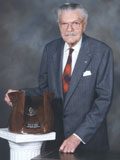
Paul Wilbur Klipsch
Paul Wilbur Klipsch
Paul Wilbur Klipsch, a great inventor, engineer, scientist, pilot, and legendary eccentric, passed away on May 5, 2002, at the age of 98. Born March 9, 1904, in Elkhart, Indiana, he was best known for revolutionizing the world of audio. Fascinated by acoustics and radio from a young age, he built his own radio receiver a year before the first public broadcast. He graduated from New Mexico A&M (now NMSU) in 1926 with a bachelor’s degree in electrical engineering.
At NMSU, Klipsch deepened his love for music and acoustics. He was a member of the championship ROTC rifle team and a charter member of the Mu Phi Pu honorary engineering fraternity. He later worked for General Electric in radio, then moved to Tocopilla, Chile (1928–1931) to supervise electric locomotive maintenance. His passion for radio continued throughout.
Returning to the U.S. in 1931, he earned a master’s degree in electrical engineering from Stanford University, continuing research in audio frequency and efficiency. From 1931–1941, he worked in Houston in oil exploration, developing eight patents in geophysical exploration. During this time, he began developing his first horn speaker patent — initially rejected.
In 1941, Klipsch was drafted into WWII and stationed at the Southwest Proving Grounds in Hope, Arkansas, contributing to ballistics and photography. He was discharged as a Major and later promoted to Lt. Colonel in the reserves.
After WWII, Klipsch committed his life to building loudspeakers. He founded Klipsch and Associates in 1946, hired his first employee in 1948, and became a pilot in 1950. Over his lifetime, he earned three patents in ballistics, eight in geophysics, and twelve in acoustics. His Heritage Line — including the Klipschorn, LaScala, Belle, Cornwall, and Heresy — remains world‑renowned.
Klipsch received numerous honors: Fellow of the IEEE, Audio Engineering Society, and Acoustical Society of America; member of Tau Beta Pi, Sigma Xi, and others. He received the NMSU Alumni Award (1966), the AES Silver Medal (1978), an Honorary Doctor of Law Degree (1981), and was inducted into the Audio Hall of Fame (1983).
In 1995, NMSU dedicated the Paul W. Klipsch Lecture Hall, the Paul W. Klipsch Department of Electrical and Computer Engineering, and the Klipsch School of Electrical Engineering. The city of Hope honored him with the Paul W. Klipsch Municipal Auditorium. In 1997, he was inducted into the Engineering and Science Hall of Fame, joining Edison, Salk, and the Wright Brothers.
Klipsch was known not only for his genius but also for his wit, eccentricity, and generosity. A 33rd Degree Mason and long‑time Rotarian, he supported countless organizations, including the Klipsch School of Electrical and Computer Engineering, the Pueblo Indian Endowment, and the American Cancer Society. He and his wife Valerie received the Circle of Excellence–Gold from NMSU in 2002.
His eccentricities were legendary — secret notebooks, the pseudonym “O. Gadfly Hurtz,” oxymorons, four watches at once, and his iconic yellow “Bullshit” button.
Klipsch lived by strong moral and ethical principles, crediting Divine Guidance for his achievements. He often quoted: “No one achieves eminence alone. If I have seen farther than Descartes, it is because I have stood on the shoulders of giants.”
He is survived by his wife Valerie, his son Raymond D. Booles, grandchildren, great‑grandchildren, and extended family.
Below is an excerpt shared by Valerie Klipsch:
“Paul Klipsch is my life… He has filled my life with love, compassion, and understanding… This intellectual giant has achieved more in a lifetime than can be imagined. How I admire him. He is my life.” — Valerie Klipsch